Best Portable Solar Chargers 2026: Panels for Travel, Camping & Van Life
We tested 8 portable solar chargers across deserts, beaches, and mountain campsites. The best solar panels for charging phones, power banks, and power stations.
Off-grid power is the silent prerequisite to off-grid internet. When you are running Starlink from a van in the Utah desert, working from a beach in Thailand with nothing but a power bank, or backpacking through Patagonia with a phone that needs to last — your solar panel is what keeps everything alive. No outlet required.
We tested 7 portable solar chargers across desert boondocking in southern Utah, beach camps on the Pacific coast of Mexico, overcast mountain mornings in Portugal, and backpacking trails in Southeast Asia. We measured real-world charging speeds, tested in direct sun and cloud cover, weighed every panel on a kitchen scale, and used them daily alongside our portable power stations and travel tech kit.
The result is this ranked guide to the best portable solar chargers in 2026, covering everything from ultralight backpacking panels to serious 100W+ van life setups.
Quick Picks: Best Portable Solar Chargers
| Feature | BigBlue 28W | EcoFlow 110W | Jackery SolarSaga 100W | Goal Zero Nomad 50 | BioLite SolarPanel 10+ | Nekteck 28W | X-Dragon 20W |
|---|---|---|---|---|---|---|---|
| Wattage | 28W | 110W | 100W | 50W | 10W | 28W | 20W |
| Weight | 1 lb 5 oz (595g) | 8.8 lbs (4 kg) | 10.3 lbs (4.7 kg) | 6 lbs (2.7 kg) | 1 lb 3 oz (539g) | 1 lb 7 oz (652g) | 21.9 oz (621g) |
| USB Ports | 2x USB-C, 1x USB-A | XT60i + Anderson | USB-A, USB-C, Anderson | USB-A + 8mm solar | 1x USB-A (2.4A) | 2x USB-A | 2x USB-A |
| Efficiency | 25.4% | 23% | 23% | ~22% | ~22% | 24% | 23.5% |
| Water Resistance | IPX4 | IP68 | IP65 | Weather-resistant | IPX4 | IPX4 | Water-resistant |
| Price | ~$73 | ~$249 | ~$250 | ~$250 | ~$80 | ~$50 | ~$35 |
| Our Pick | Best Overall | Best for Van Life | Best for Power Stations | Best for Camping | Best Ultralight | Best Budget | Ultra-Budget |
| Visit BigBlue 28W | Visit EcoFlow 110W | Visit Jackery SolarSaga 100W | Visit Goal Zero Nomad 50 | Visit BioLite SolarPanel 10+ | Visit Nekteck 28W | Visit X-Dragon 20W |
How We Tested
We did not just read spec sheets. We used these panels daily across four distinct environments over a combined 6 months of testing:
- Desert sun (Utah, Arizona). Ideal conditions with 8+ hours of direct sunlight. We measured peak output against manufacturer claims and tracked real-world charging times.
- Beach camps (Pacific coast Mexico, Thailand). High ambient temperatures, salt air, reflected light from sand. Tested how heat affects panel efficiency and whether the panels survived sandy, humid conditions.
- Mountain mornings (Portugal, Colorado). Mixed sun and cloud cover. The real test of how panels perform when conditions are not perfect.
- Overcast days. We deliberately tested every panel on fully overcast days to measure minimum useful output. This is where cheap panels fall apart and quality panels hold up.
For each panel, we measured actual watt output with a USB power meter, timed phone charges from 20% to 80%, and noted how quickly panels recovered after cloud interruptions. We also evaluated portability by carrying every panel on day hikes and multi-day camping trips.
Best Portable Solar Chargers
1. BigBlue 28W — Best Overall
The BigBlue 28W is the panel we grab for almost every trip. It is the best balance of portability, charging speed, and price for travelers who need to keep phones, tablets, and power banks charged off-grid. In direct sun, it consistently delivered 22-24W of actual output — closer to its rated 28W than any other panel in this size class.
Why it is our top pick:
- 25.4% efficiency SunPower cells. These are the same high-grade monocrystalline cells used in premium residential solar panels. The BigBlue produced 950 milliamp-hours of energy in one hour of direct sun during our testing — roughly 14% more than the identically-rated Nekteck 28W.
- Three USB ports (2x USB-C, 1x USB-A). Charge a phone, tablet, and power bank simultaneously. Each port delivers up to 5V/2.4A.
- Built-in ammeter. A small LCD display shows real-time power output in amps. This is surprisingly useful — it tells you whether your panel angle is optimal and whether cloud cover is affecting output without guessing.
- 1 lb 5 oz folded. Light enough to clip to the outside of a daypack. Folds to roughly the size of a small tablet.
- IPX4 water resistance. Handles rain showers. We got caught in a downpour in Portugal and the panel kept working. That said, we would not submerge it.
What we do not love:
- No integrated battery. When the sun goes behind a cloud, charging stops immediately. Pair it with a power bank for consistent charging.
- USB-A and USB-C only. No DC output, so you cannot charge larger power stations from this panel.
Our test results:
| Charge scenario | Time |
|---|---|
| iPhone 15 Pro (20% to 80%) | ~2 hours |
| 20,000mAh power bank (0 to full) | ~8-9 hours |
| iPad Air (20% to 80%) | ~3.5 hours |
At $73, the BigBlue 28W is our top recommendation for backpackers, travelers, and anyone who needs reliable phone and tablet charging off-grid.
Pros
- Highest real-world output in the 28W class (950mAh/hour tested)
- Built-in ammeter shows live power output
- Three USB ports charge multiple devices simultaneously
- Lightweight at 1 lb 5 oz -- clips to a backpack easily
- IPX4 water-resistant for rain showers
Cons
- No integrated battery -- charging stops when sun disappears
- No DC output for power stations
- Only USB charging -- cannot power anything beyond USB devices
2. EcoFlow 110W — Best for Van Life
The EcoFlow 110W Solar Panel is the panel we pair with our EcoFlow DELTA 2 Max power station for van life. At 110W, it charges a 1000Wh power station in roughly 10-12 hours of sun — enough to replenish a full day of remote work power consumption including Starlink.
Why it wins for van life:
- 110W actual output. In our Utah desert testing, the panel peaked at 97W of real-world output — impressive for a portable panel. Most 100W-class panels peak at 70-85W in our testing.
- IP68 waterproof. The highest water resistance rating of any panel we tested. It survived a full rainstorm in Oregon without issue. EcoFlow rates it for submersion, though we would not test that voluntarily.
- 8.8 lbs with carry case. Heavy compared to USB panels, but reasonable for a 110W panel that lives in your van and deploys at camp.
- 23% monocrystalline efficiency. 32 premium cells with ETFE film for UV protection and durability.
- Adjustable kickstand case. The carry case doubles as a stand, angling the panel toward the sun. No need for separate stands or rigging.
What to watch out for:
- No USB ports. This panel outputs via XT60i and Anderson connectors only. It is designed to charge power stations, not phones directly. You will need a power station or compatible charge controller.
- Not backpackable. At nearly 9 lbs, this is a van/car camping panel, not a hiking panel.
- $249 price. Premium pricing, but justified by the IP68 rating and EcoFlow ecosystem compatibility.
Solar charging performance (paired with EcoFlow DELTA 2 Max):
| Conditions | Daily Energy Harvested |
|---|---|
| Full sun (desert, 8+ hours) | 700-850Wh |
| Partly cloudy | 400-550Wh |
| Overcast | 150-250Wh |
Pros
- Highest real-world output of any panel tested (97W peak)
- IP68 fully waterproof -- best weather resistance available
- Integrated kickstand case for easy deployment
- Excellent EcoFlow ecosystem compatibility
- ETFE-coated cells for long-term UV durability
Cons
- No USB ports -- power station or controller required
- Too heavy for backpacking at 8.8 lbs
- Premium price at $249
- Only useful if you own a compatible power station
3. Jackery SolarSaga 100W — Best for Power Stations
The Jackery SolarSaga 100W is the go-to panel for anyone already in the Jackery ecosystem. Its bifacial design captures reflected light from the ground, and our testing showed it consistently outperformed single-sided panels of the same wattage in sandy or snowy environments.
Why it stands out:
- Bifacial panel design. The rear side captures reflected and ambient light, boosting overall output by up to 25% in our testing on light-colored surfaces (sand, concrete, snow). On dark ground (forest floor), the benefit drops to 5-10%.
- 23% cell efficiency. Matched the EcoFlow 110W in per-watt efficiency.
- USB-A + USB-C + Anderson connector. Unlike the EcoFlow, this panel can charge phones directly via USB and power stations via Anderson. More versatile for mixed use cases.
- IP65 water-resistant. Handles rain and dust. Not fully submersible like the EcoFlow, but sufficient for outdoor use.
- Folds to 24 x 21 x 1.4 inches. Compact enough to slide behind a van seat or into a storage compartment.
The downsides:
- 10.3 lbs. The heaviest panel in our lineup. The bifacial design and dual kickstands add weight.
- ~$250 price. In line with the EcoFlow 110W, which offers 10% more wattage at 1.5 lbs less weight.
- Best value within the Jackery ecosystem. If you own a Jackery power station, this is the obvious choice. If you do not, the EcoFlow 110W offers more watts per pound.
Our test results (paired with Jackery Explorer 1000 Plus):
| Conditions | Charging Time (0 to 80%) |
|---|---|
| Full sun, sand/concrete surface | ~7 hours |
| Full sun, grass/dirt surface | ~8.5 hours |
| Partly cloudy | ~12-14 hours |
Pros
- Bifacial design captures reflected light for 10-25% more output
- USB-A, USB-C, and Anderson connector -- charges phones and power stations
- Dual kickstands for easy angle adjustment
- IP65 rated for rain and dust
- Seamless Jackery ecosystem compatibility
Cons
- Heaviest panel tested at 10.3 lbs
- Bifacial benefit depends on ground surface (minimal on dark surfaces)
- Expensive at $250 for 100W
4. Goal Zero Nomad 50 — Best for Camping
The Goal Zero Nomad 50 splits the difference between the ultraportable USB panels and the heavy 100W+ van life panels. At 50W and 6 lbs, it is light enough to carry to a campsite and powerful enough to charge a mid-size power bank or small power station over a long afternoon.
Why campers love it:
- 50W from a 6 lb package. The best watts-per-pound ratio in the mid-range category. Four foldable panels maximize surface area when deployed, then pack down for transport.
- Chainable. Connect multiple Nomad panels together using Goal Zero’s proprietary chaining system. Start with one 50W panel and add more as your power needs grow.
- USB + 8mm solar port. Charges phones directly via USB and connects to Goal Zero power stations (Yeti series) via the 8mm output.
- Built-in kickstands. Sturdy flip-out stands hold the panel at an optimal angle without leaning it against anything.
- Goal Zero build quality. These panels are overbuilt. Reinforced corners, heavy-duty hinges, and weather-resistant construction. Goal Zero gear is famously durable.
What to consider:
- $250 for 50W. You are paying a premium for the Goal Zero brand and build quality. The Jackery SolarSaga 100W costs the same and offers double the wattage.
- Goal Zero ecosystem lock-in. The 8mm solar port works best with Goal Zero Yeti power stations. You can use adapters for other brands, but it is not as seamless.
- No USB-C. Only USB-A output for direct device charging. In 2026, USB-C should be standard.
Pros
- Best watts-per-pound in the mid-range (50W at 6 lbs)
- Chainable -- add panels as needs grow
- Exceptionally durable build quality
- Built-in kickstands for easy deployment
- Great for Goal Zero Yeti ecosystem
Cons
- Expensive per watt -- $5/W vs $2.50/W for 100W panels
- No USB-C port (USB-A only)
- 8mm solar port is proprietary to Goal Zero
- Heavy for its wattage compared to 100W panels
5. BioLite SolarPanel 10+ — Best Ultralight
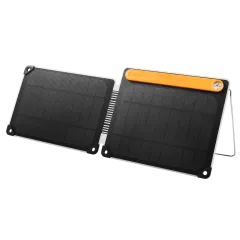
The BioLite SolarPanel 10+ is the panel you bring when every ounce matters. At 1 lb 3 oz with a built-in 3,200mAh battery, it is the only panel in our lineup that stores energy for later — meaning a passing cloud does not immediately kill your charge.
Why backpackers should consider it:
- Integrated 3,200mAh battery. This is the key differentiator. The panel charges its internal battery during the day, and you can charge your phone from the battery at night or when the sun disappears. No separate power bank needed for short trips.
- 1 lb 3 oz total weight. Including the battery. Lighter than the BigBlue 28W despite having a built-in power bank.
- Optimal Sun System with sundial. A built-in analog sundial and alignment indicator help you position the panel for maximum output. Sounds gimmicky, but it genuinely helped us squeeze 10-15% more power by nailing the angle.
- 360-degree kickstand. Works on uneven terrain, flat surfaces, and can be hung from a branch or tent line.
- IPX4 splash-proof. Handles light rain and splashing.
The trade-offs:
- 10W output. Significantly lower than the 28W panels. Phone charging takes 4-6 hours in direct sun instead of 2-3 hours.
- ~$80 price. More expensive per watt than the BigBlue or Nekteck. You are paying for the integrated battery and clever design.
- 3,200mAh battery is small. It stores roughly 60-70% of one phone charge. Useful as a buffer, not as a primary power bank.
Best for: Ultralight backpackers, thru-hikers, and travelers who want a single device that both captures and stores solar energy.
Pros
- Built-in 3,200mAh battery stores energy for later use
- Lightest panel tested at 1 lb 3 oz (including battery)
- Sundial alignment system for optimal sun positioning
- 360-degree kickstand works on any terrain
- One device replaces a small solar panel + small power bank
Cons
- Only 10W output -- slow phone charging (4-6 hours)
- Internal battery only holds ~60-70% of one phone charge
- Expensive per watt at $80 for 10W
- Not practical for tablets or power banks
6. Nekteck 28W — Best Budget
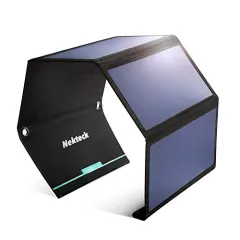
The Nekteck 28W is essentially the BigBlue 28W’s more affordable twin. Same form factor, same 28W rating, similar SunPower-grade cells — but at roughly $50 instead of $73. The catch? In our testing, it delivered about 12% less real-world output than the BigBlue.
Why it is a solid budget pick:
- ~$50 price. The cheapest 28W panel worth buying. At this price, it is an easy recommendation for first-time solar charger buyers.
- 24% efficient Maxeon cells. Slightly lower than the BigBlue’s 25.4%, but still high-quality monocrystalline cells.
- Dual USB-A ports. Each delivers up to 5V/2.4A. Total combined output of 5V/4A.
- IPX4 water resistance. Same rain protection as the BigBlue.
- 1 lb 7 oz. Just 2 oz heavier than the BigBlue. Negligible difference in a pack.
Where it falls short:
- No USB-C. USB-A only. You will need a USB-A to USB-C cable for modern devices.
- No ammeter. You cannot see real-time output. The BigBlue’s ammeter is a genuine advantage for optimizing panel angle.
- Lower real-world output. We measured 834mAh/hour vs the BigBlue’s 950mAh/hour in identical conditions. The BigBlue’s higher efficiency cells make a measurable difference.
Bottom line: If budget is your primary concern and you can live without USB-C and the ammeter, the Nekteck 28W delivers 90% of the BigBlue experience for 68% of the price.
Pros
- Best price for a 28W panel at ~$50
- High-quality Maxeon cells with 24% efficiency
- Dual USB-A ports for simultaneous charging
- IPX4 water-resistant
- Nearly identical form factor to the BigBlue
Cons
- No USB-C ports -- USB-A only
- No ammeter to monitor real-time output
- 12% less real-world output than the BigBlue 28W
- Minor build quality differences (thinner fabric, lighter carabiners)
7. X-Dragon 20W — Ultra-Budget Pick
The X-Dragon 20W is the cheapest functional solar charger we tested. At around $35, it costs less than a dinner for two in most cities. It is not going to win any performance awards, but for occasional use — a weekend camping trip, emergency backup, or a budget traveler who wants solar without committing serious money — it does the job.
What you get for $35:
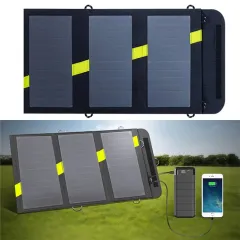
- 20W SunPower cells with 23.5% efficiency. Surprisingly good cell quality at this price point.
- Dual USB-A ports. Up to 2A per port, 3A total. Charges two phones simultaneously, albeit slowly.
- 21.9 oz (621g). Comparable weight to the premium 28W panels.
- Durable Oxford fabric. Water-resistant construction with carabiners for hanging.
What you sacrifice:
- Lower real-world output than 28W panels. We measured roughly 15-16W of actual output in direct sun. Phone charging takes 3-4 hours instead of 2-3.
- No USB-C. USB-A only.
- Less consistent in variable conditions. When clouds rolled in, the X-Dragon’s output dropped more dramatically than the BigBlue or Nekteck. Its charging circuit recovers slower after sun interruptions.
- Build quality is adequate, not premium. Thinner materials, lighter hinges. It will last a season of moderate use, but we would not trust it on a thru-hike.
Best for: Budget-conscious campers, festival-goers, emergency kits, or anyone who wants to try solar charging without spending much.
Pros
- Cheapest functional solar charger at ~$35
- Decent SunPower cells with 23.5% efficiency
- Dual USB-A ports for two devices
- Lightweight and foldable
Cons
- Only 20W -- noticeably slower than 28W panels
- No USB-C ports
- Output drops sharply in cloudy or variable conditions
- Build quality will not survive heavy long-term use
Solar Charger Buying Guide
Not sure which panel to get? Here is what actually matters when choosing a portable solar charger.
Wattage: How Much Do You Need?
| Use Case | Recommended Wattage | Example Panels |
|---|---|---|
| Phone charging only | 10-20W | BioLite 10+, X-Dragon 20W |
| Phone + tablet + power bank | 28W | BigBlue 28W, Nekteck 28W |
| Portable power station charging | 60-110W | Jackery SolarSaga 100W, EcoFlow 110W |
| Full van life setup (Starlink + power station) | 200W+ | Dual EcoFlow 110W or dedicated roof panels |
The sweet spot for most travelers is 28W. It charges a phone in 2-3 hours of direct sun, handles tablets, and can slowly charge a power bank. It also folds small enough to fit in a daypack.
Panel Type: Monocrystalline vs. Polycrystalline
Every panel in this guide uses monocrystalline cells, and for good reason. Monocrystalline panels deliver 20-25% efficiency versus 15-17% for polycrystalline. In a portable panel where surface area is limited, higher efficiency per square inch is essential. Do not buy a polycrystalline portable panel in 2026 — the technology has been surpassed.
USB Output: USB-C vs. USB-A
USB-C is the future and most modern devices (phones, tablets, earbuds, cameras) use it. Panels with USB-C output can deliver power more efficiently and at higher wattages. The BigBlue 28W has USB-C; the budget options (Nekteck, X-Dragon) are USB-A only. If your primary devices are USB-C, prioritize panels with native USB-C ports.
Weight and Portability
For backpacking: target under 1.5 lbs. The BioLite 10+ (1 lb 3 oz) and BigBlue 28W (1 lb 5 oz) are the top choices.
For car camping or van life: weight matters less. A 100-110W panel at 8-10 lbs is manageable since you are not carrying it on your back.
For air travel: foldable panels without built-in batteries have no airline restrictions. They fit in checked luggage or a large carry-on.
Durability and Water Resistance
| Rating | Protection | Panels |
|---|---|---|
| IP68 | Submersible, fully dustproof | EcoFlow 110W |
| IP65 | Dust-tight, low-pressure water jets | Jackery SolarSaga 100W |
| IPX4 | Splash-proof from any direction | BigBlue 28W, Nekteck 28W, BioLite 10+ |
| Water-resistant | Survives light rain | X-Dragon 20W, Goal Zero Nomad 50 |
If you camp in wet climates, the EcoFlow 110W’s IP68 rating is unmatched.
Pairing Solar with Power Stations
A solar panel and a portable power station are the ultimate off-grid power combo for van lifers and remote workers. The panel charges the station during the day; the station powers your laptop, Starlink, phone, and lights around the clock.
Recommended Pairings
| Solar Panel | Pairs Best With | Daily Energy (Full Sun) |
|---|---|---|
| EcoFlow 110W | EcoFlow DELTA 2 Max, RIVER 2 Pro | 700-850Wh |
| Jackery SolarSaga 100W | Jackery Explorer 1000 Plus | 600-750Wh |
| Goal Zero Nomad 50 | Goal Zero Yeti 500X, 1500X | 300-400Wh |
Compatibility matters. EcoFlow panels work best with EcoFlow power stations. Jackery panels pair seamlessly with Jackery stations. Goal Zero uses proprietary connectors that work best within their ecosystem. Cross-brand pairing is possible with adapters, but you lose the seamless plug-and-play experience and sometimes sacrifice charging efficiency.
For running Starlink off-grid, we recommend at least 200W of solar panel capacity. A single 110W panel will not fully replenish a power station that ran Starlink all day. Two EcoFlow 110W panels (220W total) or one Jackery SolarSaga 200W panel will get you closer to energy independence. See our Starlink van life guide for the complete setup breakdown.
The Verdict
For most travelers and backpackers, the BigBlue 28W is the best portable solar charger. It offers the highest real-world output in its size class, has USB-C ports, includes an ammeter, and costs $73. It has been our daily-use panel for over a year.
For van lifers and power station owners, the EcoFlow 110W delivers the best combination of output, weather resistance, and ecosystem compatibility. If you own a Jackery power station, the Jackery SolarSaga 100W is the obvious choice.
For ultralight hikers, the BioLite SolarPanel 10+ is unmatched — built-in battery, sundial alignment, and under 1.5 lbs.
For budget-conscious buyers, the Nekteck 28W at $50 delivers 90% of the BigBlue’s performance.
Whichever panel you choose, pair it with a solid power bank and you have a power setup that works anywhere the sun shines.
Frequently Asked Questions
How many watts do I need in a portable solar charger?
It depends on what you are charging. 10-20W is enough for phone charging only, though it will be slow. 28W is the sweet spot for most travelers -- it charges a phone in 2-3 hours of direct sun and can handle tablets and power banks. 60-100W panels are designed for charging portable power stations. 200W+ panels are for full van life setups running Starlink and multiple devices. If you are a backpacker or casual traveler, 28W is the best balance of portability and output. For van lifers powering a Starlink dish, 200W or more is the starting point.
Can I charge a laptop directly from a solar panel?
Most portable solar panels output USB only, which is not enough to charge a laptop directly. You need either a 60W+ panel with USB-C Power Delivery output (rare in portable panels) or, more practically, charge a portable power station or high-capacity power bank from the solar panel and then charge your laptop from that. The two-step approach is more reliable and lets you work while the panel charges your battery in the background.
Do solar chargers work on cloudy days?
Yes, but output drops significantly -- typically 50-70% less than direct sun. A 28W panel might produce only 8-14W in overcast conditions. Thin cloud cover has less impact than heavy overcast. Direct sunlight hitting the panel at a perpendicular angle gives the best results. Cloudy days are fine for slow phone charging, but will not meaningfully charge a portable power station. If you camp in frequently overcast areas, size up your panel by 50% compared to what you think you need.
How long does it take to charge a phone with a solar charger?
Charging time depends on panel wattage and sunlight conditions. A 28W panel in direct sun charges a modern smartphone (4,500-5,000mAh) in roughly 2-3 hours. A 10W panel takes 4-6 hours for the same phone. A 100W panel can charge a phone in under an hour, though that is overkill for phone charging alone. These times assume direct sun and an efficient charging circuit. Partial shade, clouds, or a suboptimal panel angle will increase charging times.
Can I bring a solar panel on a plane?
Yes. Portable solar panels without built-in batteries are allowed in both carry-on and checked luggage with no restrictions. They contain no lithium batteries and are not classified as dangerous goods by any airline. Foldable panels under 28W easily fit inside a backpack or carry-on. If your solar charger has an integrated battery (like the BioLite SolarPanel 10+), the battery portion must comply with airline lithium battery rules -- its 3,200mAh battery is well under the 100Wh limit, so it is allowed in carry-on.
Solar charger vs power bank -- which should I get?
Get both. They solve different problems. A power bank (20,000mAh) gives you instant stored power for daily use -- plug in and charge anywhere, anytime. A solar charger replenishes your power bank when you have no access to outlets. For city travel, hostels, and coworking spaces, a power bank alone is sufficient. For camping, hiking, van life, or extended off-grid travel, add a solar charger to keep your power bank topped up indefinitely. The combination makes you fully energy-independent.