Best Sleep Accessories for Travel 2026: Beat Jet Lag and Sleep Anywhere
We tested sleep masks, earplugs, white noise machines, and melatonin aids across 50+ flights and 30+ time zones. The best travel sleep gear for frequent flyers.
After two years of full-time travel — crossing 30+ time zones, sleeping in 50+ different beds, enduring overnight buses, red-eye flights, and hostel dorms with early-morning risers — we have learned one absolute truth: sleep quality determines everything. Your productivity, mood, health, and ability to enjoy a new destination all hinge on how well you slept.
The environments you sleep in while traveling are inherently hostile to good sleep. Hotel curtains that do not fully close. Street noise at 2 AM. Jet lag that has your body convinced it is noon when the clock says midnight. A partner with a 6 AM alarm in a shared hostel dorm.
You cannot control these environments. But you can control what you bring to block them out. After extensive testing, we found that three items under $100 total transform sleep quality in any environment: a quality sleep mask, good earplugs, and a portable white noise machine.
Here is everything we tested and what actually works.
Quick Comparison: Best Travel Sleep Accessories
| Feature | Manta Sleep Mask | Loop Quiet | LectroFan Micro2 | Howard Leight MAX | Alaska Bear Silk Mask |
|---|---|---|---|---|---|
| Category | Sleep Mask | Earplugs | White Noise Machine | Earplugs (Foam) | Sleep Mask |
| Light Blocking | 100% | - | - | - | 95% |
| Weight | 32g | 4g | 56g | ~1g per pair | 18g |
| Adjustable | Yes (eye cups + strap) | 4 tip sizes included | Volume + sound type | Roll-down insertion | Elastic strap |
| Side Sleep | Comfortable | Excellent (low profile) | N/A (bedside device) | Good (some pressure) | Good (flat profile) |
| Material | Modal + memory foam | Soft silicone | Plastic | Polyurethane foam | Mulberry silk |
| Price | ~$35 | ~$25 | ~$35 | ~$12 (50 pairs) | ~$10 |
| Our Pick | Best Sleep Mask | Best Earplugs | Best White Noise | Best Budget Earplugs | Best Budget Mask |
| Noise Reduction | - | 26 dB NRR | - | 33 dB NRR | - |
| Sound Options | - | - | Fan + white noise | - | - |
| Visit Manta Sleep Mask | Visit Loop Quiet | Visit LectroFan Micro2 | Visit Howard Leight MAX | Visit Alaska Bear Silk Mask |
How We Tested
We tested each accessory under real travel conditions, not in a quiet bedroom at home:
- Flight testing. Each mask and earplug combination was tested on at least three flights over 4 hours, including overnight transatlantic routes where sleep quality directly impacted arrival-day productivity.
- Hostel/shared room testing. Dorm rooms with early risers, late arrivals, and the inevitable person who rustles plastic bags at 5 AM.
- Hotel room testing. Tested light leakage from curtain gaps, hallway noise, and street noise across 30+ hotel stays.
- Time zone adjustment. Used each sleep mask during daytime naps as part of jet lag recovery protocols crossing 5-12 time zones.
- Side sleeper testing. Our primary tester is a side sleeper, which is the hardest sleeping position for both sleep masks (pressure on the mask) and earplugs (ear pressed against pillow). Every product was evaluated specifically for side-sleeper compatibility.
- Durability. How does each item hold up after 3+ months of daily use, frequent washing, and being stuffed into a travel bag?
Best Travel Sleep Accessories
Sleep Masks
1. Manta Sleep Mask — Best Overall Sleep Mask
The Manta Sleep Mask changed our relationship with sleep in transit. Unlike flat fabric masks that press against your eyelids and let light leak around your nose bridge, the Manta uses individually adjustable eye cups that create a complete blackout cavity around each eye.
The eye cups are made of memory foam wrapped in modal fabric and attach to the mask’s base with thin, repositionable discs. You can move each cup independently to fit your face shape, eye socket depth, and nose bridge width. This adjustability is why the Manta blocks 100% of light for virtually every face shape — something flat masks cannot achieve without uncomfortable pressure.
The eye cup design has a secondary benefit: zero eyelid pressure. Your eyes sit in a dark cavity with space to blink freely. This matters for two reasons. First, pressure on the eyelids disrupts REM sleep. Second, if you wear contact lenses or have dry eyes, the open cavity prevents the friction that flat masks create.
The strap uses a dual-adjustment system with hook-and-loop fastening. Unlike single-elastic-strap masks that ride up or shift during sleep, the Manta stays precisely positioned all night. Our side-sleeper tester confirmed it did not shift during position changes throughout the night.
At 32 grams, the Manta is heavier than flat silk masks but still negligible in a travel bag. The eye cups add bulk compared to flat masks — it does not fold as flat in a pocket. The included travel pouch helps with organization.
We have used the same Manta mask for 14 months with regular washing (hand wash, air dry) and the foam maintains its shape, the fabric remains soft, and the hook-and-loop attachment points still grip firmly.
Pros
- 100% light blocking with adjustable eye cups
- Zero eyelid pressure -- eyes blink freely in cavity
- Individually adjustable cup positions for any face shape
- Dual-adjustment strap stays put for side sleepers
- Modal fabric is soft and breathable
- Durable construction survives 14+ months of daily travel use
Cons
- $35 is expensive for a sleep mask
- Bulkier than flat masks -- does not fold as compactly
- Eye cups can shift if strap is too loose
- Hand wash only -- not machine washable
- Takes a few nights to find your optimal cup position
Best for: Any traveler who wants the best possible sleep mask. The adjustable eye cups and zero-pressure design justify the premium for anyone sleeping in multiple environments weekly.
Check Manta Sleep Mask on Amazon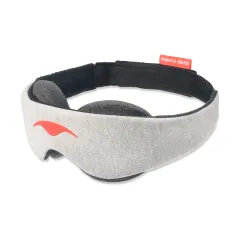
2. Alaska Bear Silk Mask — Best Budget Sleep Mask
The Alaska Bear Natural Silk Sleep Mask is the mask to buy if you want something better than airline freebies without spending $35. At $10, it is the best-selling sleep mask on Amazon with over 80,000 reviews and a 4.4-star average.
The mulberry silk material feels genuinely premium against skin — cool, smooth, and non-irritating. Silk breathes better than synthetic fabrics, which matters in warm climates where a polyester mask becomes a sweaty face sauna.
Light blocking is rated at roughly 95% — not the total blackout of the Manta, but close enough for most environments. A sliver of light leaks around the nose bridge, which is the inherent weakness of flat mask designs. For flights and dark hotel rooms, this is negligible. For daytime naps in bright rooms, the light leakage is noticeable.
At 18 grams, the Alaska Bear is the lightest mask on this list and folds completely flat. It takes up almost no space — slip it into a jacket pocket or the smallest compartment of your bag. The elastic strap is comfortable but less adjustable than the Manta’s dual-strap system, which means it may not fit all head sizes perfectly.
Durability is acceptable for the price. After 3-4 months of daily use and regular washing, the elastic starts to lose tension and the silk develops some pilling. At $10, replacing it every few months is reasonable.
Pros
- Genuine mulberry silk -- cool, smooth, breathable
- Ultra-lightweight at 18g -- folds completely flat
- $10 is accessible for any budget
- 80,000+ reviews with 4.4-star Amazon average
- Multiple color options
- Comfortable for most face shapes
Cons
- 95% light blocking -- some nose bridge leakage
- Elastic strap loses tension after 3-4 months
- Not adjustable for different head sizes
- Silk pills with frequent washing
- Flat design puts some pressure on eyelids
Best for: Budget travelers, first-time sleep mask buyers, and anyone who wants a compact, lightweight mask that is easily replaceable. An excellent entry point before investing in a Manta.
Check Alaska Bear Silk Mask on Amazon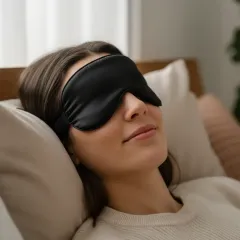
Earplugs
3. Loop Quiet — Best Reusable Earplugs
The Loop Quiet earplugs have become our permanent travel companion. Unlike foam earplugs that must be rolled, inserted, and expanded (a process that never works well with groggy 3 AM fingers), Loop Quiet earplugs insert like standard earbuds — push in, twist to seal, done.
The 26 dB noise reduction blocks the sounds that disrupt sleep — conversations, traffic noise, snoring, hostel door slams — while still allowing you to hear a loud alarm clock or smoke detector. This is a meaningful difference from the 33 dB reduction of foam plugs: Loop Quiet removes the noise that prevents sleep without creating the total isolation that makes some people anxious.
Four sizes of soft silicone tips (XS, S, M, L) ensure a proper seal for any ear canal. Finding the right size takes one minute of testing and creates a comfortable fit that you can wear all night without pain or pressure. Our side-sleeper tester confirmed that the low-profile design does not create discomfort when the ear is pressed against a pillow — a major advantage over foam plugs, which expand and press against the ear canal.
The silicone material is washable and reusable. A quick rinse with warm soapy water between uses keeps them hygienic. We have used the same pair for 8+ months with no degradation in noise reduction or silicone softness.
Loop Quiet comes in multiple colors and includes a compact carrying case that clips onto a keychain or fits inside any bag pocket.
Pros
- Insert like earbuds -- no rolling/expanding required
- 26 dB reduces sleep-disrupting noise without total isolation
- Extremely comfortable for side sleepers (low profile)
- 4 tip sizes for perfect ear canal fit
- Washable and reusable -- 8+ months per pair
- Compact carrying case included
Cons
- $25 is expensive compared to disposable foam plugs
- 26 dB is less noise reduction than foam (33 dB)
- Can fall out during very active sleep if tip size is wrong
- Silicone can cause mild irritation for some ear canals
Best for: Travelers who want comfortable, reusable earplugs for nightly use in any sleeping environment. The side-sleeper comfort makes these the best choice for the majority of travelers.
Check Loop Quiet on Amazon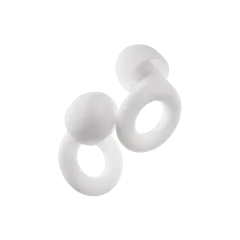
4. Howard Leight MAX — Best Disposable Earplugs
The Howard Leight MAX-1 foam earplugs are the nuclear option for noise. At 33 dB NRR, they block more noise than any other consumer earplug and cost roughly $0.24 per pair in bulk. For hostel dorms, overnight buses, and construction noise outside your hotel, nothing else comes close.
The bell-shaped design creates a deep seal that blocks virtually everything. Roll the foam between your fingers, insert, wait 30 seconds for expansion, and the world goes quiet. Snoring bunkmates, street traffic, barking dogs, early-morning construction — all reduced to barely perceptible background murmur.
The trade-off is comfort. Foam earplugs expand to fill your ear canal, creating pressure that some people find uncomfortable after 6+ hours. Side sleepers experience additional pressure from pillow compression against the expanded foam. The disposable nature means you go through pairs quickly — we used roughly 2-3 pairs per week during heavy travel periods.
For the price, this is a non-issue. A 50-pair box costs $12 and lasts months. Throw a handful in each bag, pocket, and jacket. Use them once and discard. The per-use cost is negligible.
We recommend keeping both Loop Quiet and Howard Leight MAX in your travel kit. Use the Loop Quiet for normal nightly use (hotel rooms, quiet Airbnbs). Switch to Howard Leight MAX for high-noise environments (hostels, overnight transport, noisy neighborhoods).
Pros
- Highest noise reduction at 33 dB NRR
- Dirt cheap at $0.24 per pair in bulk
- 50-pair box lasts months
- Deep bell shape creates excellent seal
- Individually wrapped pairs stay clean in travel bags
- No carrying case needed -- toss extras in every pocket
Cons
- Foam pressure can be uncomfortable after 6+ hours
- Less comfortable for side sleepers than Loop Quiet
- Roll-and-insert technique takes practice
- Disposable -- creates waste over time
- Total noise isolation can make some people anxious
Best for: High-noise environments, hostel dorms, overnight buses, and anyone who wants the maximum possible noise reduction at the lowest possible cost.
Check Howard Leight MAX on Amazon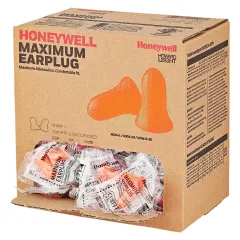
White Noise Machine
5. LectroFan Micro2 — Best Portable White Noise Machine
The LectroFan Micro2 solves a problem that earplugs alone cannot: inconsistent noise. Earplugs reduce overall noise volume, but they cannot mask the sudden sounds that jolt you awake — a door slam, a car horn, a conversation that starts unexpectedly. A white noise machine creates a consistent sound floor that masks these sudden disruptions.
The Micro2 is remarkably small — 56 grams and roughly the size of a hockey puck. It fits in a jeans pocket and adds negligible weight to any bag. Despite its size, the speaker delivers surprisingly full sound that fills a hotel room effectively. We placed it on a nightstand 2-3 feet from the pillow and it masked street noise from open windows in Mexico City and Chiang Mai.
Sound options include fan sounds and white noise at adjustable volumes. The fan sounds are realistic and pleasant — not the thin, tinny reproduction of a phone app. The built-in rechargeable battery lasts up to 8 hours, which covers a full night’s sleep. Charges via micro-USB (a minor annoyance in a USB-C world, but not a dealbreaker for a device you charge once every 1-2 days).
The Micro2 also functions as a Bluetooth speaker for phone calls, podcasts, and music during the day. It is not an audiophile speaker, but it works well enough for casual listening, which gives it dual-purpose utility that justifies its spot in your bag.
The combination of Manta Sleep Mask + Loop Quiet earplugs + LectroFan Micro2 is our complete travel sleep kit. Total weight: 92 grams. Total cost: ~$95. Impact on sleep quality: transformative.
Pros
- Tiny (56g) and pocketable -- negligible pack weight
- Surprisingly full sound fills a hotel room
- Masks sudden noise disruptions that earplugs cannot
- 8-hour battery covers a full night
- Doubles as a Bluetooth speaker during the day
- Fan and white noise options with volume control
Cons
- $35 for a white noise machine when phone apps are free
- Micro-USB charging (not USB-C)
- 8-hour battery means charging every 1-2 nights
- Not effective in very loud environments without earplugs
- Speaker is small -- limited maximum volume
Best for: Light sleepers who are disturbed by sudden noises (door slams, traffic, conversations) rather than constant background noise. Essential for hotel rooms with thin walls and noisy streets.
Check LectroFan Micro2 on Amazon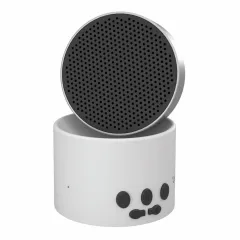
The Complete Travel Sleep Kit
Here is our recommended sleep kit, organized by priority:
Essential (Start Here)
- Manta Sleep Mask ($35) — or Alaska Bear ($10) if budget is tight
- Loop Quiet earplugs ($25) — comfortable enough for nightly use
- A handful of Howard Leight MAX foam plugs ($12/50) — for high-noise backup scenarios
Upgraded
- LectroFan Micro2 ($35) — if you are a light sleeper disturbed by sudden sounds
- Melatonin (0.5-1mg) — for jet lag recovery when crossing 3+ time zones
Total Kit Weight: Under 100g
Total Kit Cost: Under $100
This combination addresses every sleep disruptor we encountered across two years of full-time travel. It is the travel equivalent of a quality mattress and blackout curtains at home — the foundation everything else is built on.
For related travel comfort gear, see our best noise canceling headphones for travel, best travel pillows, and digital nomad health guide. For packing everything efficiently, check our digital nomad packing list.
Frequently Asked Questions
What is the best way to sleep on a long flight?
The most effective combination is a contoured sleep mask that blocks 100% of light, foam or silicone earplugs that reduce noise by 30+ dB, and a comfortable neck pillow. This trio eliminates the two biggest sleep disruptors on flights: light and noise. Add melatonin (0.5-1mg taken 30-60 minutes before your desired sleep time) if you are crossing more than 3 time zones. Avoid alcohol before sleeping on a flight -- it disrupts sleep quality even if it helps you fall asleep faster. Wear compression socks and stay hydrated.
Do sleep masks actually help you sleep better?
Yes, significantly. A 2022 study published in Sleep journal found that wearing an eye mask during sleep improved next-day alertness, episodic memory encoding, and reaction time. Light exposure during sleep disrupts melatonin production and circadian rhythm, even through closed eyelids. A quality sleep mask that blocks 100% of light enables deeper sleep in any environment -- planes, hostels, bright hotel rooms, and daytime naps when adjusting to a new time zone.
How do you deal with jet lag as a digital nomad?
The most effective jet lag protocol combines light exposure management and sleep timing adjustment. For eastward travel: expose yourself to bright light in the morning and avoid it in the evening for 2-3 days. For westward travel: seek light in the afternoon and evening. Melatonin (0.5-3mg) taken at your target bedtime helps reset your internal clock. A blackout sleep mask lets you sleep at your target times regardless of ambient light. Stay hydrated, avoid caffeine after 2 PM local time, and exercise during daylight hours. Most people adjust at a rate of about 1 time zone per day.
Are silicone earplugs better than foam for travel?
Both have advantages. Foam earplugs (like Howard Leight MAX) offer the highest noise reduction (NRR 33 dB) and cost pennies per pair. They are disposable and ideal for flights and hostels. Silicone earplugs (like Loop Quiet) are reusable, more comfortable for side sleepers (lower profile), and reduce noise by a consistent 26-27 dB. They cost more upfront but save money over time. For travel, we carry both: silicone for nightly use and a bag of foam earplugs as disposable backups for flights and noisy hostel environments.
Can you use noise canceling headphones for sleeping?
Active noise canceling headphones are excellent for reducing ambient noise while awake but are generally not comfortable enough for sleeping, especially side sleeping. Most over-ear headphones create pressure points when lying down. In-ear options like AirPods Pro work for back sleepers but are uncomfortable for side sleepers and carry the risk of falling out during sleep. For sleeping, dedicated earplugs outperform headphones. Use noise canceling headphones during waking hours on flights and switch to earplugs when you are ready to sleep.
Is melatonin safe for frequent travel use?
Melatonin is generally considered safe for short-term use in healthy adults. The American Academy of Sleep Medicine recommends doses of 0.5-5mg for jet lag management. Most research suggests that lower doses (0.5-1mg) are as effective as higher doses with fewer side effects. Take melatonin 30-60 minutes before your target bedtime. It is not a sleeping pill -- it signals to your body that it is time to sleep, which is why it is most effective for time zone adjustment rather than general insomnia. Consult a healthcare provider if you are using it more than 2-3 times per week.