Best Travel Surge Protectors 2026: Protect Your Gear Abroad
We tested 6 compact surge protectors with USB-C for international travel. Protect laptops, phones, and gear from voltage spikes in hotels and co-working spaces.
A power surge in a Bali guesthouse fried our colleague’s MacBook charger at 2am. No warning, no lightning, just an electrical grid that hiccupped while they slept. The 60W USB-C charger was dead by morning — melted internals, faint burning smell, $80 replacement needed from a Jakarta electronics store three days later.
That same surge ran through a surge protector on our side of the room. Our laptop, phone, camera charger, and power bank all woke up fine.
That is the pitch for a travel surge protector in one sentence: $25-40 protects thousands of dollars in electronics from a threat you cannot predict or prevent. Power grids in Southeast Asia, Latin America, parts of Europe, and Africa experience voltage fluctuations that North American power rarely sees. Hotels, guesthouses, and Airbnbs are especially vulnerable — old wiring, overloaded circuits, and inconsistent grounding are the norm, not the exception.
We have been testing compact travel surge protectors across 15+ countries over the past year, evaluating joule ratings, USB-C charging speeds, portability, and international voltage compatibility. Here are the ones worth carrying.
Quick Comparison: Best Travel Surge Protectors
| Feature | Anker 521 Power Strip | Belkin SurgePlus USB-C | EPICKA TA-105 Pro | APC SurgeArrest PE63 | Tripp Lite Protect It TLP606USBB | LENCENT Universal Travel Adapter |
|---|---|---|---|---|---|---|
| Surge Rating | 1,200 joules | 900 joules | Internal fuse (10A) | 1,080 joules | 990 joules | Internal fuse |
| USB-C | 1x 30W PD | 1x 30W PD | 3x (70W PD) | None | None | 2x (45W PD) |
| USB-A | 2x | 2x | 2x | None | 2x | 3x |
| AC Outlets | 3x | 4x | 1x (universal) | 6x | 6x | 1x (universal) |
| Voltage | 120V only (AC) | 120V only (AC) | 100-240V (dual) | 120V only (AC) | 120V only (AC) | 100-240V (dual) |
| Weight | 10.4 oz | 12.5 oz | 8.3 oz | 14 oz | 13 oz | 7.8 oz |
| Price | ~$16 | ~$30 | ~$36 | ~$20 | ~$22 | ~$28 |
| Our Pick | Best Overall | Best Brand Trust | Best International | Most AC Outlets | Best Budget | Best Compact |
| Visit Anker 521 Power Strip | Visit Belkin SurgePlus USB-C | Visit EPICKA TA-105 Pro | Visit APC SurgeArrest PE63 | Visit Tripp Lite Protect It TLP606USBB | Visit LENCENT Universal Travel Adapter |
How We Tested
We evaluated each surge protector on the criteria that matter for travel — not lab conditions, but the real-world demands of nomad life:
- Surge protection rating. Joule rating, MOV quality, and whether protection status is clearly indicated by LED.
- USB-C PD wattage. Can it fast-charge a phone? Can it charge a laptop? We measured actual USB-C output with a power meter.
- International compatibility. Is it dual-voltage (100-240V)? Does it work with a travel adapter at 220V? We tested at both 120V and 220V.
- Portability. Weight, size, cord length, and whether it fits in a tech pouch.
- Build quality and safety certification. UL/ETL listing, fire-resistant materials, and build durability after months of travel.
- Outlet count and spacing. How many devices can you protect and charge simultaneously?
Best Travel Surge Protectors for 2026
1. Anker 521 Power Strip — Best Overall
The Anker 521 is the surge protector we reach for most often — and the same device that topped our best travel power strips guide, because it happens to be both. Three AC outlets, two USB-A ports, and one 30W USB-C PD port, all behind 1,200 joules of surge protection. At $16, it is absurdly good value.
The 1,200-joule rating is the highest on this list and comfortably handles the voltage spikes common in hotel and guesthouse wiring. An LED indicator on the strip confirms that surge protection is active — if it goes out, the MOV is depleted and the strip is acting as a basic power strip without protection (time to replace it).
Anker’s ActiveShield 2.0 temperature monitoring is not marketing fluff — it continuously checks internal temperature and adjusts power output to prevent overheating. We ran this strip continuously for 72 hours in a humid Chiang Mai room with four devices charging and never measured surface temperatures above warm-to-touch.
The 30W USB-C PD port charges an iPhone to 50% in about 30 minutes and handles an iPad at full speed. It will not charge most laptops at full speed (you need 65W+ for that), but it will maintain charge on a MacBook Air.
The limitation: The AC outlets are 120V only. The USB ports are dual-voltage (100-240V) and work worldwide, but if you plug the AC outlets into a 220V outlet via a travel adapter, only the USB charging is safe — the AC pass-through is receiving 220V, which is fine for dual-voltage devices like laptop chargers but dangerous for 120V-only appliances. Most of your electronics are dual-voltage (check the fine print on each charger), but verify before plugging anything in at 220V.
Pros
- 1,200 joules — highest surge protection on this list
- 30W USB-C PD fast charges phones and tablets
- Only $16 — best value surge protector available
- ActiveShield 2.0 temperature monitoring
- 5ft cord wraps neatly for travel
- LED confirms surge protection is active
- $200,000 connected equipment warranty
Cons
- AC outlets are 120V rated — USB ports work worldwide but AC needs care at 220V
- 30W USB-C is not enough for most laptops
- Banned on cruise ships
- US plug — needs adapter for international outlets
- 10.4 oz — not the lightest option
Best for: Most travelers who want reliable surge protection with USB-C charging at an unbeatable price.
Check Anker 521 on Amazon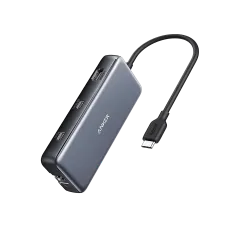
2. Belkin SurgePlus USB-C — Best Brand Trust
The Belkin SurgePlus is for travelers who want a name they trust behind their surge protection. Belkin has been making surge protectors for decades, and the SurgePlus delivers a well-built, reliable unit with 900 joules of protection, four AC outlets, two USB-A ports, and one 30W USB-C PD port.
The build quality is noticeably more robust than budget competitors. The housing is thick, fire-resistant plastic with a solid feel. The rotating plug sits flat against the wall and rotates 360 degrees, which is useful for tight spaces behind hotel nightstands. Four AC outlets with wide spacing accommodate bulky charger bricks without blocking adjacent ports.
Belkin backs this with a $75,000 connected equipment warranty — if your device is damaged by a surge while connected to this protector, Belkin pays. That kind of warranty signals confidence in the product’s surge protection capability.
Pros
- Belkin brand reliability and quality
- 900 joules with $75,000 connected equipment warranty
- 30W USB-C PD charging
- 4 widely-spaced AC outlets accommodate large chargers
- 360-degree rotating plug for tight spaces
- Robust, fire-resistant build quality
Cons
- 12.5 oz — heaviest compact option on this list
- 120V AC outlets only — USB ports work worldwide
- $30 — pricier than the Anker with lower joule rating
- Banned on cruise ships
- US plug requires adapter internationally
Best for: Travelers who prioritize build quality and brand trust over lowest price.
Check Belkin SurgePlus on Amazon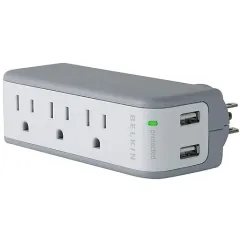
3. EPICKA TA-105 Pro — Best for International Travel
The EPICKA TA-105 Pro is not a traditional surge protector — it is a universal travel adapter with GaN 70W charging and built-in fuse protection. While it does not have a traditional MOV surge protector with a joule rating, its 10A replaceable fuse and internal circuit protection guard against overloads and short circuits. For international travel where you need plug conversion and power protection in one device, it is the most practical option.
The key advantage: it is truly dual-voltage (100-240V) with universal plug compatibility. The built-in adapter slides work in 200+ countries — US, EU, UK, and Australian plug types. You do not need a separate travel adapter. Three USB-C ports (one at 70W PD) charge any laptop on the market. The universal AC pass-through outlet handles one additional device.
We used the EPICKA as our primary international charger for five months across Southeast Asia and Europe. The 70W USB-C port fully charged a MacBook Air in under two hours. The universal plug system worked flawlessly in Thailand, Portugal, the UK, and Germany without carrying a single adapter.
The trade-off: It is fuse protection, not joule-rated surge protection. A 10A fuse will blow during a significant overload, cutting power and protecting your devices — but it does not absorb smaller surges the way an MOV-based surge protector does. For most hotel and Airbnb scenarios, the fuse protection plus your devices’ built-in voltage regulation is sufficient.
Pros
- True dual-voltage (100-240V) — works safely worldwide
- Universal adapter built-in — no separate adapter needed
- 70W USB-C PD charges any laptop at full speed
- 5 USB ports total — phone, laptop, tablet, watch, earbuds
- 10A replaceable fuse protects against overloads
- Only 8.3 oz — lighter than most surge protectors
Cons
- Fuse protection, not MOV surge protection — no joule rating
- Only 1 AC outlet pass-through
- $36 — premium pricing
- 70W only from USB-C1; other ports share remaining power
- No traditional surge indicator LED
Best for: International travelers who want plug conversion, USB-C charging, and power protection in one compact device.
Check EPICKA TA-105 Pro on Amazon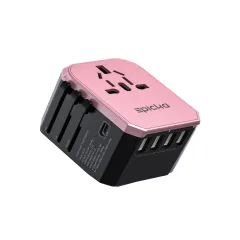
4. APC SurgeArrest PE63 — Most AC Outlets
The APC SurgeArrest PE63 is the option for travelers who need to protect many AC-powered devices simultaneously. Six outlets with 1,080 joules of protection in a compact strip format. No USB ports — this is pure surge protection for your existing chargers and devices.
APC is one of the most respected names in power protection (they make the UPS systems that protect data centers), and the PE63 reflects that pedigree. The MOV components are high quality, the 6-foot cord is heavy gauge, and the surge protection LED is clear and reliable.
We used the PE63 in a long-term Airbnb in Medellin where we had a full workstation — laptop charger, monitor, external hard drive, desk lamp, phone charger, and camera charger. Six outlets meant everything stayed protected without rotation.
Pros
- 6 AC outlets — most on this list
- 1,080 joules — strong surge protection
- APC brand — trusted name in power protection
- 6-foot cord reaches across hotel rooms
- Clear surge protection status LED
- ~$20 — affordable for the protection level
Cons
- No USB ports — bring your own chargers
- 14 oz — heavier than compact alternatives
- 120V AC only — not for direct international use at 220V
- Bulkier than travel-specific designs
- Banned on cruise ships
- US plug only
Best for: Travelers with a full workstation setup who need to protect many devices from a single surge protector.
Check APC SurgeArrest PE63 on Amazon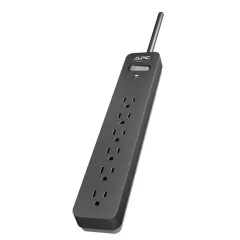
5. Tripp Lite Protect It TLP606USBB — Best Budget
The Tripp Lite Protect It is a no-frills surge protector with solid specs at a budget price. Six AC outlets, two USB-A ports, 990 joules of protection, and a 6-foot cord — all for around $22. Tripp Lite is another brand with deep roots in power protection, and this model is their most portable offering.
The 990 joules is adequate for hotel and Airbnb use. Two USB-A ports (2.4A shared) handle phone and tablet charging at moderate speeds but lack USB-C PD. If you need USB-C fast charging, pair this with your own USB-C charger plugged into one of the protected AC outlets.
Pros
- 6 AC outlets with 990 joules protection at $22
- Tripp Lite brand reliability
- 2 USB-A ports for basic phone/tablet charging
- 6-foot cord for flexible placement
- $50,000 connected equipment warranty
- Diagnostic LEDs confirm protection and grounding status
Cons
- No USB-C ports — need your own USB-C charger
- 13 oz — mid-weight for travel
- 120V AC only — not dual-voltage
- USB-A ports are 2.4A shared — slow charging
- Banned on cruise ships
- US plug requires adapter abroad
Best for: Budget travelers who want reliable surge protection from a trusted brand without paying for USB-C features.
Check Tripp Lite Protect It on Amazon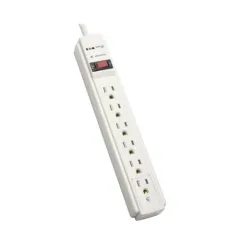
6. LENCENT Universal Travel Adapter — Best Compact
The LENCENT Universal Travel Adapter is the most portable option here, combining universal plug compatibility, dual 45W USB-C PD, three USB-A ports, and fuse protection in a device that weighs just 7.8 ounces.
Like the EPICKA, this is fuse protection rather than MOV surge protection. The 10A replaceable fuse cuts power during overloads, protecting your devices from the most dangerous scenarios. It is not the same as joule-rated surge absorption, but it handles the power events that actually cause damage in travel scenarios.
The 45W USB-C PD output charges most ultrabooks and every phone at fast-charging speeds. The compact, all-in-one design eliminates the need for a separate travel adapter, charger, and surge protector — three devices in one.
Pros
- Lightest at 7.8 oz — most portable option
- Universal plug works in 200+ countries
- Dual 45W USB-C PD — charges laptops and phones
- 3 USB-A ports for additional devices
- True dual-voltage (100-240V)
- ~$28 — good value for the features
Cons
- Fuse protection only — no MOV joule-rated surge protection
- Only 1 AC pass-through outlet
- 45W USB-C is adequate but not enough for large laptops
- Total wattage shared across all ports
- Slightly bulkier than a standard travel adapter
Best for: Minimalist travelers who want plug conversion, USB-C charging, and basic power protection in the smallest possible package.
Check LENCENT Travel Adapter on Amazon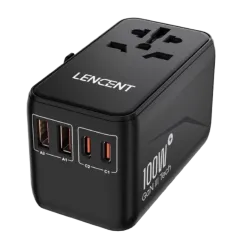
Surge Protector vs Power Strip: Why It Matters
The difference can save your gear. A power strip adds outlets — it is just an extension cord with multiple sockets. A surge protector contains a metal oxide varistor (MOV) that absorbs excess voltage before it reaches your devices.
When a power surge hits — from lightning, grid switching, or generator kick-on — voltage can spike from the normal 120V or 220V to 300V or more for a fraction of a second. That spike flows through a power strip unchanged and into your laptop. Through a surge protector, the MOV absorbs the excess energy and only lets normal voltage through.
How to tell them apart: Look for a joule rating on the packaging. If it says “600 joules” or “1,200 joules,” it is a surge protector. If there is no joule rating and no MOV indicator light, it is just a power strip. Price alone does not tell you — some expensive power strips have zero surge protection.
For our non-surge power strip recommendations (including cruise-approved options), see our best travel power strips guide.
International Voltage: The Critical Safety Detail
This is the section that most travel gear guides skip, and it is the section that prevents fires.
US-rated surge protectors (120V) plugged into 220V outlets:
The USB ports on modern surge protectors are dual-voltage (100-240V) and work safely worldwide. The AC pass-through outlets are the concern. A US-rated surge protector’s AC outlets pass through whatever voltage comes from the wall. At 220V, this means:
- Dual-voltage devices (laptop chargers, phone chargers, camera chargers): Safe. Check the fine print on each charger — if it says “Input: 100-240V,” it handles 220V without issue.
- 120V-only devices (some hair dryers, electric razors, US-specific appliances): Dangerous. They will receive 220V through the pass-through and can overheat or catch fire.
- The MOV component: Some MOVs are rated for 120V only. At 220V, the MOV may see the normal voltage as a “surge” and attempt to clamp it, causing overheating. Always verify your surge protector’s voltage rating before using it internationally.
The safe approach: If you travel internationally, either use a dual-voltage surge protector (like the EPICKA or LENCENT) or only use the USB ports on your US-rated surge protector when connected to 220V outlets. For a complete guide to plug types and adapters, see our best travel adapters guide.
The Bottom Line
For most travelers staying primarily in the US or using the USB ports internationally, the Anker 521 at $16 is unbeatable — 1,200 joules, 30W USB-C PD, and Anker’s excellent build quality.
For international travelers who need a true dual-voltage solution with plug conversion, the EPICKA TA-105 Pro combines universal adapter, 70W USB-C charging, and fuse protection in one 8.3-ounce device.
A $25-40 surge protector protecting $2,000+ in electronics is the easiest cost-benefit calculation in your travel kit. Pack one, forget about it, and let it quietly save your gear from the electrical surprise you never see coming.
For the complete power setup, see our best travel power strips and best travel adapters guides. For the full tech kit, check our digital nomad packing list.
Frequently Asked Questions
Do I need a surge protector when traveling internationally?
In many countries, yes. Power grids in parts of Southeast Asia, Latin America, Africa, and Eastern Europe experience voltage fluctuations and power surges more frequently than in North America or Western Europe. A surge can fry your laptop, phone charger, or camera in an instant. If you are carrying $2,000+ in electronics, a $25-40 surge protector is cheap insurance. Modern devices have some built-in voltage regulation, but it is not designed to handle significant surges.
What is the difference between a surge protector and a power strip?
A power strip simply adds more outlets — it provides no protection. A surge protector contains a metal oxide varistor (MOV) that diverts excess voltage away from your devices during a power surge. Some power strips include surge protection and some do not. Always check the joule rating — if there is no joule rating on the packaging, it is just a power strip. For travel, you want at least 600-1000 joules of protection.
Can I bring a surge protector on a cruise ship?
No. Most cruise lines explicitly ban surge protectors due to fire safety concerns. Carnival, Norwegian, Royal Caribbean, Princess, Holland America, MSC, and Celebrity all confiscate surge protectors at embarkation. Non-surge power strips are allowed on most lines except Royal Caribbean. If you are cruising, see our separate guide on the best travel power strips which covers cruise-approved options.
How many joules of surge protection do I need?
For travel, 600-1000 joules is adequate for protecting laptops, phones, and small electronics. This handles the most common voltage spikes encountered in hotels and apartments. Higher ratings (1000-2000+ joules) offer more protection but come in larger, heavier units that are less practical for travel. Most surges in buildings are relatively small — the MOV absorbs them easily at 600+ joules.
Do USB-C chargers need surge protection?
USB-C PD chargers have internal voltage regulation that handles minor fluctuations, but they are not immune to significant surges. A direct lightning strike or major grid surge can overwhelm any internal protection. Plugging your USB-C charger into a surge protector adds an extra layer of defense. It is especially important in countries with unreliable power infrastructure where surges are more frequent.
Does a surge protector work with different voltages (120V vs 220V)?
Some do, some do not — and this is critical for international travel. The surge protection circuitry (MOV) in most US-market surge protectors is rated for 120V only. Plugging a 120V-rated surge protector into a 220V outlet can damage the protector and potentially start a fire. Always verify that your surge protector is rated for 100-240V input if you plan to use it internationally, or only use the USB ports (which are universally dual-voltage) when abroad.