Best USB-C Travel Chargers 2026: GaN Chargers Tested in 30+ Countries
We tested 7 GaN USB-C chargers across 30+ countries for size, heat, compatibility, and charging speed. The best compact chargers for digital nomads.
The single best upgrade to our travel tech setup was replacing three separate chargers — laptop brick, phone charger, and tablet charger — with one compact GaN charger and a short USB-C cable. That swap eliminated 300+ grams of dead weight, freed up a power strip outlet at every coworking space, and simplified our cable bag from a tangled mess to a clean pouch.
GaN (Gallium Nitride) technology made this possible. These chargers pack 65-100+ watts into packages smaller than a traditional phone charger, run cooler than silicon-based chargers, and support the USB Power Delivery standard that lets one charger power everything from an iPhone to a MacBook Pro.
After testing 7 GaN chargers across 30+ countries — through sketchy voltage fluctuations in Southeast Asian hostels, underpowered outlets in European apartments, and cafe outlets shared with 15 other nomads — here are the chargers that earned a permanent spot in our bag.
Quick Comparison: Best USB-C Travel Chargers
| Feature | Anker Prime 67W | Ugreen Nexode 100W | Baseus 65W GaN | Anker Nano II 65W | Anker 737 120W |
|---|---|---|---|---|---|
| Total Wattage | 67W | 100W | 65W | 65W | 120W |
| Ports | 2 USB-C + 1 USB-A | 3 USB-C + 1 USB-A | 2 USB-C + 1 USB-A | 1 USB-C | 2 USB-C + 1 USB-A |
| Size | 2.0 x 1.6 x 1.4 in | 2.6 x 2.6 x 1.3 in | 2.0 x 1.5 x 1.3 in | 1.7 x 1.7 x 1.5 in | 3.0 x 1.7 x 1.5 in |
| Weight | 138g | 218g | 120g | 112g | 187g |
| GaN Gen | GaN Prime | GaN II | GaN III | GaN II | GaN Prime |
| Foldable Prongs | Yes | Yes | Yes | Yes | Yes |
| Price | ~$40 | ~$60 | ~$26 | ~$36 | ~$75 |
| Our Pick | Best Overall | Best Multi-Device | Best Budget | Most Compact | Best for Power Users |
| Visit Anker Prime 67W | Visit Ugreen Nexode 100W | Visit Baseus 65W GaN | Visit Anker Nano II 65W | Visit Anker 737 120W |
How We Tested
Every charger was tested under real travel conditions, not lab benchmarks:
- Charging speed. We timed 0-100% charges on a MacBook Air M3, iPhone 15 Pro, and iPad Air using each charger. We also tested simultaneous multi-device charging to measure real-world wattage splitting.
- Heat under load. GaN chargers run warm, but some get dangerously hot. We measured surface temperatures during sustained full-load charging in ambient temperatures ranging from air-conditioned coworking spaces (22C) to hot hotel rooms in Thailand (32C).
- Size and weight. Measured with calipers and a precision scale. We compared each charger against the original laptop charger it replaces.
- Voltage compatibility. Tested on outlets across 30+ countries with voltages ranging from 100V (Japan) to 240V (UK, Australia, Southeast Asia). Confirmed stable operation without buzzing, flickering, or overheating.
- Durability. Prong durability after hundreds of plug-unplug cycles, cable strain relief, and finish wear after months in a cable pouch.
- Foldable prongs. Critical for travel — chargers with fixed prongs snag on everything in your bag and bend over time.
Best USB-C Travel Chargers for Digital Nomads
1. Anker Prime 67W — Best Overall
The Anker Prime 67W is the charger we have carried daily for over a year. It replaced the MacBook Air charger, the iPhone charger, and the iPad charger — three devices reduced to one charger that fits in a closed fist.
At 138 grams and roughly the size of a golf ball, the Prime 67W is almost half the size of Apple’s 67W MagSafe charger. It has 2 USB-C ports and 1 USB-A port, which covers every device we carry. The single-port maximum of 67W charges a MacBook Air from 0-50% in approximately 30 minutes. When using two ports simultaneously, it splits to roughly 45W + 20W — enough to charge a laptop at near-full speed while fast-charging a phone.
The foldable prongs are non-negotiable for travel, and the Prime 67W executes them well. They fold completely flush with the body, creating a smooth brick that does not snag on bag linings or scratch other gear. Many budget chargers have foldable prongs that wobble after a few months — the Prime’s mechanism still feels tight after 12+ months of daily use.
Heat management is excellent. During a full 67W MacBook Air charge in a 30C hotel room in Vietnam, the charger surface reached 52C — warm but not uncomfortable to touch and well within safe operating range. Some budget 65W chargers hit 65C+ under the same conditions.
Anker’s PowerIQ 4.0 technology negotiates the optimal charging protocol for each device automatically. USB PD, PPS, Quick Charge — it detects and delivers the right one without manual selection.
At $40, it is not the cheapest option, but the combination of compact size, port count, build quality, and Anker’s 24-month warranty makes it the easiest recommendation on this list.
Pros
- Incredibly compact at 138g -- fits in a closed fist
- 3 ports (2 USB-C + 1 USB-A) covers all devices
- 67W single-port charges any ultrabook at full speed
- Foldable prongs with tight mechanism after 12+ months
- Excellent heat management under full load
- PowerIQ 4.0 auto-negotiates charging protocol
- 24-month Anker warranty
Cons
- 67W total -- splits to ~45W + 20W with two devices
- Not enough for MacBook Pro 16-inch at full speed
- $40 is more than budget alternatives
- USB-A port maxes at 22.5W
Best for: Digital nomads with an ultrabook (MacBook Air, ThinkPad X1, XPS 13) and a phone. This is the one-charger-for-everything solution most travelers need.
Check Anker Prime 67W on Amazon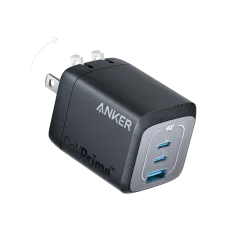
2. Ugreen Nexode 100W — Best for Multi-Device Charging
If you carry more than two devices, the Ugreen Nexode 100W is the charger that eliminates cable management anxiety. Four ports — 3 USB-C and 1 USB-A — handle a laptop, phone, tablet, and earbuds simultaneously from one wall outlet.
The 100W total output means even with multiple devices connected, each port gets enough power to charge meaningfully. A realistic scenario: MacBook Pro at 65W on port 1, iPhone at 20W on port 2, iPad at 15W on port 3. All three charging simultaneously, all three making real progress.
Single-port maximum is 100W, which covers even power-hungry laptops like the MacBook Pro 14-inch and larger Windows ultrabooks. For travelers with MacBook Pro 16-inch models that ship with 96W or 140W chargers, the Nexode 100W provides full-speed charging on a single port.
At 218 grams, it is heavier and larger than the Anker Prime 67W. The size is roughly comparable to a standard Apple 67W charger, which makes sense given the higher wattage and extra port. For travelers who prioritize maximum portability above all else, the Anker Prime is a better fit. For those who want to charge their entire tech ecosystem from one brick, the Nexode justifies its size.
Ugreen’s build quality has improved significantly over the past two years. The Nexode features a matte finish that resists fingerprints, foldable prongs, and solid port construction. It handled voltage fluctuations in India and Cambodia without issues, and surface temperatures stayed at 55C during sustained 100W charging — higher than the Anker but still safe.
Pros
- 100W total output charges everything simultaneously
- 4 ports (3 USB-C + 1 USB-A) for full tech ecosystem
- 100W single-port charges MacBook Pro 14/16 at full speed
- Foldable prongs for travel
- Matte finish resists fingerprints and scratches
- Excellent value at $60 for 100W
Cons
- Larger and heavier at 218g -- not pocket-sized
- Runs warmer (55C) than smaller chargers
- Wattage splits aggressively with 3+ devices connected
- Slightly louder coil whine than Anker under heavy load
Best for: Power users who carry a laptop, phone, tablet, and accessories. Ideal for couples sharing one charger or anyone who wants to consolidate to a single wall adapter for everything.
Check Ugreen Nexode 100W on Amazon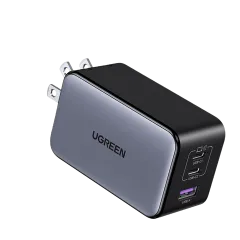
3. Baseus 65W GaN — Best Budget
The Baseus 65W GaN delivers 90% of the Anker Prime 67W’s performance at 65% of the price. At $26 and 120 grams, it is the lightest and cheapest multi-port GaN charger worth recommending.
Three ports (2 USB-C + 1 USB-A) cover the standard nomad setup. The primary USB-C port delivers 65W for laptop charging. The secondary USB-C delivers 30W for phone fast-charging. Both can operate simultaneously with the expected wattage splitting.
Where Baseus cuts corners is in the details. The foldable prongs have slightly more play than Anker’s after a few months of use. The finish is glossy plastic rather than matte, which shows fingerprints and minor scratches. The internal temperature sensor is less aggressive about thermal management — the charger surface reached 58C during sustained 65W output in a warm room, compared to Anker’s 52C.
None of these compromises are dealbreakers. The Baseus charges devices at the same speed, supports the same USB PD protocol, and handles international voltages identically. It simply does so with less polish and refinement. For a charger that lives in a cable pouch and gets plugged in twice a day, that trade-off is rational for many travelers.
Baseus includes an 18-month warranty, which is shorter than Anker’s 24 months but standard for the price category.
Pros
- Exceptional value at $26 for 65W GaN
- Lightest multi-port option at 120g
- 3 ports (2 USB-C + 1 USB-A) covers all devices
- Foldable prongs for travel
- Supports USB PD, PPS, and Quick Charge
- Compact form factor comparable to premium options
Cons
- Foldable prongs develop slight play over time
- Runs warmer than Anker under sustained load (58C)
- Glossy finish shows fingerprints
- 18-month warranty (shorter than Anker)
- Less refined thermal management
Best for: Budget-conscious travelers who want multi-port GaN charging without paying premium prices. An excellent first GaN charger or backup travel charger.
Check Baseus 65W GaN on Amazon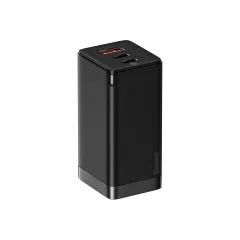
4. Anker Nano II 65W — Most Compact Single-Port
The Anker Nano II 65W is the smallest 65W charger available — period. At 112 grams and roughly the size of a standard phone charger, it is almost absurdly small for the power it delivers. This one charger replaces both your laptop brick and phone charger, assuming you charge them sequentially rather than simultaneously.
The trade-off is obvious: one USB-C port. You can charge your laptop or your phone, not both at once. For some travelers, this is a dealbreaker. For ultralight packers who carry a single USB-C cable and charge their laptop during work, then switch to their phone overnight, it is perfectly adequate.
At 65W, the Nano II charges a MacBook Air M3 from 0-100% in approximately 90 minutes — identical speed to the Anker Prime 67W. It supports USB PD 3.0 and PPS, so it fast-charges every USB-C phone and tablet on the market.
The build is pure Anker. Matte finish, tight foldable prongs, excellent heat management (50C under sustained 65W load), and the brand’s 24-month warranty. Despite its tiny size, there is no compromise in charging performance or safety.
For travelers who want multi-device charging, pair the Nano II with a $15 Anker 20W phone charger and you still have a smaller, lighter total kit than any single multi-port charger above.
Pros
- Smallest 65W charger in existence at 112g
- Charges any ultrabook at full 65W speed
- Foldable prongs with Anker build quality
- Excellent heat management -- 50C under full load
- 24-month Anker warranty
- Disappears in any pocket or bag corner
Cons
- Single USB-C port -- one device at a time
- Cannot charge laptop and phone simultaneously
- Not enough for MacBook Pro 16-inch at full speed
- $36 for a single-port charger feels steep
Best for: Ultralight packers, minimalists, and travelers who want the absolute smallest laptop charger available. Pair with a cheap 20W phone charger for a complete sub-150g charging kit.
Check Anker Nano II 65W on Amazon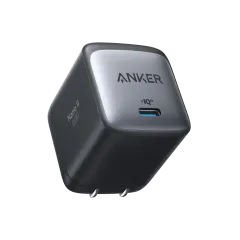
5. Anker 737 120W — Best for Power Users
The Anker 737 is the charger for travelers who carry heavy-duty laptops and refuse to compromise on charging speed. At 120W total output, it delivers enough power to fast-charge a MacBook Pro 16-inch, a phone, and a tablet simultaneously without meaningful wattage splitting.
The single-port maximum of 100W handles every consumer laptop on the market at full speed. When charging a MacBook Pro 16-inch and an iPhone simultaneously, the split (roughly 85W + 25W) keeps both devices charging at near-optimal rates.
At 187 grams, the 737 is larger than the other Anker options but still dramatically smaller than the 140W Apple MagSafe charger it replaces. The foldable prongs, matte finish, and GaN Prime internals are consistent with Anker’s quality standards.
This is overkill for MacBook Air users, but essential for anyone carrying a MacBook Pro 16-inch, Dell XPS 15, ThinkPad X1 Extreme, or similar performance laptop. The 120W headroom ensures your laptop charges at full speed even while you are using it under heavy load, which lower-wattage chargers cannot guarantee.
Pros
- 120W total output -- handles any laptop at full speed
- 3 ports (2 USB-C + 1 USB-A) for multi-device charging
- 100W single-port charges MacBook Pro 16-inch
- Still smaller than Apple's 140W charger
- GaN Prime technology with excellent heat management
- 24-month Anker warranty
Cons
- Largest charger on this list at 187g
- $75 is expensive for a charger
- Overkill for ultrabook users
- Runs warm (55C) under sustained 120W load
Best for: Travelers with MacBook Pro 16-inch, gaming laptops, or performance ultrabooks that draw 96W+. Also ideal for professionals who need to charge multiple devices simultaneously at maximum speed.
Check Anker 737 120W on Amazon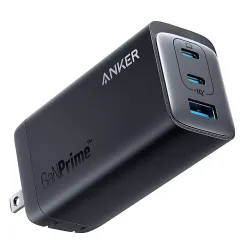
Do Not Forget: You Still Need a Travel Adapter
A GaN charger handles voltage conversion internally (100-240V), but it does not change the physical plug shape. You need a universal travel adapter to fit different outlets worldwide. Check our best travel adapters guide for our tested recommendations.
For the complete cable and charging ecosystem, see also:
- Best portable chargers for laptops — power banks that charge your laptop on the go
- Best travel cable kit — organizing your cables and chargers
- Best power banks for travel — backup power when outlets are unavailable
- Digital nomad packing list — everything you need in your tech bag
The Bottom Line
A GaN USB-C charger is the most impactful upgrade for any traveler still carrying a full-size laptop brick. For most digital nomads, the Anker Prime 67W ($40) is the right choice — it charges any ultrabook at full speed, handles three devices, and fits in your palm. Budget travelers should grab the Baseus 65W ($26), which delivers the same core functionality at a lower price. Power users with MacBook Pro 16-inch or similar should step up to the Anker 737 120W ($75).
Whichever you choose, the day you replace your laptop brick with a GaN charger is the day your cable bag loses its most annoying resident.
Frequently Asked Questions
What is a GaN charger and why is it better for travel?
GaN (Gallium Nitride) is a semiconductor material that replaces silicon in modern chargers. GaN chargers convert power more efficiently, produce less heat, and can deliver higher wattage in a significantly smaller package. A 65W GaN charger is roughly half the size of a traditional 65W silicon charger. For travelers, this means you can charge your laptop with a charger smaller than a deck of cards instead of carrying a bulky laptop brick. GaN chargers also run cooler, which is safer in hot climates and when packing in enclosed bags.
Can one USB-C charger charge both my laptop and phone?
Yes, if the charger has enough wattage and multiple ports. A 65W charger with two USB-C ports can typically charge a laptop on one port and a phone on the other simultaneously, though each port delivers reduced wattage when both are in use. For example, a 65W charger might split to 45W and 20W across two ports. A 100W+ charger gives you enough headroom to fast-charge both devices at full speed simultaneously. This means you can leave your laptop brick and phone charger at home and carry one compact charger.
How many watts do I need for my laptop?
Most ultrabooks (MacBook Air, ThinkPad X1, Dell XPS 13) charge at 30-45W. MacBook Pro 14-inch and similar performance laptops need 65-70W. MacBook Pro 16-inch and gaming laptops need 96-140W. Check the wattage printed on your current laptop charger to know your minimum requirement. You can use a charger with higher wattage than your laptop requires -- the laptop only draws what it needs. But a charger with lower wattage than required will charge your laptop very slowly or only maintain the battery without charging.
Do USB-C chargers work with all plug types worldwide?
USB-C chargers that support 100-240V input (which is virtually all modern chargers) work with any country's voltage. However, you still need a physical plug adapter to fit different outlet shapes. A universal travel adapter converts the plug shape but does not change voltage. Since your GaN charger already handles 100-240V internally, a simple inexpensive adapter is all you need -- no voltage converter required. See our guide to the best travel adapters for recommendations.
Is it safe to charge my laptop with a third-party USB-C charger?
Yes, as long as the charger uses USB Power Delivery (USB PD) protocol, which is an industry standard. All reputable GaN chargers from Anker, Ugreen, Baseus, and similar brands support USB PD and negotiate the correct voltage and amperage with your device automatically. Your laptop will only draw the power it needs. Avoid no-name chargers without USB PD certification, as they may deliver incorrect voltages. We recommend sticking to established brands with UL/CE safety certifications.
Should I get a 65W or 100W charger?
For most digital nomads with an ultrabook and a phone, 65W is the sweet spot. It charges any ultrabook at full speed, fast-charges phones, and keeps the charger compact. Get 100W+ if you have a MacBook Pro 16-inch, a high-performance laptop that needs 96W+, or you want to simultaneously fast-charge a laptop and a tablet without wattage splitting slowing things down. 100W chargers are slightly larger but still dramatically smaller than traditional laptop bricks.