Best Mobile Hotspot with Unlimited Data 2026
We tested truly unlimited hotspot plans from T-Mobile, AT&T, and Verizon. Real-world data on deprioritization, throttling, and the best unlimited hotspot options.
“Unlimited data.” Two words that every carrier plasters across their marketing, and two words that almost never mean what you think they mean.
We learned this the hard way on month three of full-time RV travel. Our AT&T “unlimited” hotspot plan throttled to 600 Kbps after 40 GB — turning our Zoom calls into pixelated slideshows and our cloud backups into overnight operations. That was when we started testing every “unlimited” hotspot option we could find, measuring real-world speeds before and after deprioritization thresholds, during peak congestion, and on different tower densities.
After 10 months of testing across five carriers, three dedicated hotspot devices, and hundreds of speed tests, here is the truth about unlimited mobile hotspot data in 2026 — what is truly unlimited, what is “unlimited with an asterisk,” and which plans give you the most usable data for the money.
🏆 Quick Picks
Amazon
Netgear Nighthawk M6 + T-Mobile Go5G Plus SIM. 50 GB premium then deprioritized.
From $400 + $90/mo
Amazon
T-Mobile 5G Gateway. Truly unlimited, no throttling, $50/mo. Requires AC power.
From $0 (included) + $50/mo
Amazon
GL.iNet Beryl AX + phone tethering. Use your phone's unlimited plan through a router.
From $80 + existing plan
The Truth About “Unlimited” Hotspot Data
Before we recommend any plans or devices, you need to understand three terms that carriers use interchangeably but mean very different things:
Truly Unlimited (No Throttling, No Deprioritization)
Your data is never slowed down, no matter how much you use. This is what most people expect when they hear “unlimited.” In 2026, the only mainstream option in this category is T-Mobile 5G Home Internet ($50/month) — and it requires a fixed location with AC power.
Deprioritized After X GB
You get a bucket of “premium” data (typically 50-100 GB). After you exceed it, your data continues but is deprioritized — meaning during tower congestion, other users get priority. In practice, deprioritization may not affect you at all during off-peak hours or in areas with low congestion. During rush hour on a congested urban tower, you might see speeds drop from 100 Mbps to 5-15 Mbps. Your data never stops — it just slows during busy periods.
Hard Throttled After X GB
After a fixed amount (typically 15-50 GB), your speeds are artificially reduced to a fixed rate — often 600 Kbps to 3 Mbps — regardless of network conditions. This is the worst “unlimited” experience. Even if the tower is completely empty at 3am, your speeds stay throttled until the next billing cycle.
Best Unlimited Hotspot Plans in 2026
| Feature | T-Mobile 5G Home Internet | T-Mobile Go5G Plus (phone plan) | Calyx Institute Hotspot | AT&T Unlimited Premium (phone plan) | Verizon Unlimited Ultimate (phone plan) | Visible+ (Verizon MVNO) |
|---|---|---|---|---|---|---|
| Truly Unlimited | Yes | No | Effectively yes | No | No | No |
| Throttle/Deprioritize | None | Deprioritized after 50 GB | Deprioritized (no hard cap) | Deprioritized after 60 GB | Deprioritized after 60 GB | Deprioritized after 50 GB |
| Monthly Cost | $50 | $90/line | ~$42 (annual donation) | $85/line | $90/line | $45 |
| Hardware | Gateway included | Your phone or hotspot | Included with membership | Your phone or hotspot | Your phone or hotspot | Your phone |
| Portable | No (AC power, address-locked) | Yes | Yes | Yes | Yes | Yes (phone tethering only) |
| 5G | Yes | Yes | Yes (device dependent) | Yes | Yes (UW included) | Yes |
| Best For | Stationary unlimited | Most portable data | Best value unlimited | AT&T coverage areas | Urban 5G UW areas | Budget unlimited |
How We Tested
We did not just read spec sheets and carrier marketing pages. We tested unlimited hotspot plans over 10 months of real-world use:
- Data volume tracking. We tracked monthly usage on each plan to identify exactly when throttling or deprioritization kicked in. We regularly exceeded 100-200 GB per month to test the true “unlimited” claims.
- Speed tests before and after thresholds. At each carrier’s deprioritization threshold, we ran speed tests every hour for 48 hours to measure the real-world impact. Tests were conducted at different times of day and on towers with varying congestion levels.
- Tower congestion impact. We tested deprioritized speeds in congested urban areas (downtown Denver, Austin, Miami) versus uncongested suburban and rural towers to measure how much deprioritization actually affects you.
- Multi-carrier comparison. We ran T-Mobile, AT&T, and Verizon SIMs through the same hotspot device at the same locations to compare network performance and deprioritization policies.
- Remote work usability. After hitting deprioritization thresholds, we tested real work tasks — Zoom calls, Slack, Google Workspace, large file uploads — to determine whether the deprioritized connection was genuinely usable for remote work.
Best Hotspot Devices for Unlimited Plans
Before we dig into plans, the hotspot hardware matters. Here are the best devices to pair with an unlimited data plan:
| Feature | Netgear Nighthawk M6 (MR6150) | GL.iNet Beryl AX (MT3000) | Inseego MiFi X PRO 5G | Franklin T10 |
|---|---|---|---|---|
| Cellular | 5G Sub-6 / 4G LTE | None (USB tethering) | 5G Sub-6 / 4G LTE | 4G LTE Cat 9 |
| Battery | 5040mAh (13 hours) | None (USB-C powered) | 4730mAh (12 hours) | 3000mAh (10 hours) |
| WiFi | WiFi 6 | WiFi 6 AX3000 | WiFi 6 | WiFi 5 |
| Ext. Antenna | 2x TS-9 | None | 2x TS-9 | None |
| Devices | 32 | 32 | 30 | 10 |
| SIM | Nano SIM + eSIM | N/A (uses phone) | Nano SIM | Nano SIM |
| Price | ~$400 | ~$80 | ~$350 | ~$100 |
| Best For | Most users | Budget / phone tethering | Nighthawk alternative | Budget 4G |
| Visit Netgear Nighthawk M6 (MR6150) | Visit GL.iNet Beryl AX (MT3000) | Visit Inseego MiFi X PRO 5G | Visit Franklin T10 |
Best Unlimited Hotspot Plans in 2026
1. T-Mobile 5G Home Internet — Truly Unlimited, Stationary
T-Mobile’s 5G Home Internet is the only mainstream option that delivers genuinely unlimited data with no throttling and no deprioritization threshold. For $50/month, you get a 5G/4G gateway device (included free), plug it into a wall outlet, and enjoy unlimited internet.
The fine print: T-Mobile technically requires you to use this service at a registered address where T-Mobile confirms coverage. It is designed as home internet, not travel internet. The gateway requires AC power (no battery) and weighs over 4 lbs. That said, RVers and van lifers have been using T-Mobile Home Internet on the road — enforcement of the address lock is inconsistent, and some users have reported months of mobile use without issues.
For stationary setups — a long-term Airbnb, seasonal RV site, or a fixed location where you need unlimited data — this is the best value by far. For more on RV-specific setups, see our best mobile hotspot for RV guide.
Our real-world experience: At a suburban location with T-Mobile 5G coverage, the gateway delivered consistent 150-250 Mbps download speeds. We used over 800 GB in one month (heavy video streaming, large file transfers, daily video calls) with zero speed reduction at any point.
Pros
- Truly unlimited -- no throttling, no deprioritization threshold
- $50/month -- cheapest unlimited option by far
- Gateway device included free -- zero upfront hardware cost
- 5G + 4G LTE with strong internal antennas
- WiFi 6 with 64 connected devices
Cons
- Requires AC power -- no battery, not portable
- Address-locked -- technically must use at registered location
- Gateway is large and heavy (4+ lbs)
- Only available where T-Mobile confirms coverage
- Not designed for travel -- enforcement of address lock may tighten
2. T-Mobile Go5G Plus with Nighthawk M6 — Best Portable
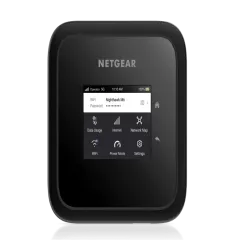
For portable unlimited data, the best setup is the Netgear Nighthawk M6 with a T-Mobile Go5G Plus SIM. You get 50 GB of premium hotspot data before deprioritization, and the data continues unlimited after that — just potentially slower during peak congestion.
In our testing, deprioritization after 50 GB was barely noticeable in most scenarios. In rural and suburban areas with low tower congestion, speeds stayed above 50 Mbps even at 100+ GB of usage. In dense urban areas during peak hours, we saw speeds drop to 8-15 Mbps after the 50 GB threshold — slower but still usable for video calls and work.
The Nighthawk M6’s external antenna ports (TS-9) allow you to add a MIMO antenna for dramatically better signal in weak coverage areas — turning marginal 5-10 Mbps into usable 30-50 Mbps. For a full review, see our Netgear Nighthawk M6 review.
Pros
- 50 GB premium data before any speed impact
- Data continues unlimited after 50 GB (deprioritized, not throttled)
- Portable -- Nighthawk M6 has 13-hour battery
- External antenna ports for signal improvement
- 5G + 4G LTE with carrier flexibility (unlocked device)
- WiFi 6 and 32 connected devices
Cons
- $90/month for Go5G Plus plan
- $400 for Nighthawk M6 hardware
- Deprioritization can reduce speeds to 5-15 Mbps in congested areas
- 50 GB premium threshold is reachable for heavy users in 2-3 weeks
- Requires T-Mobile coverage -- dead zones exist in rural areas
3. Calyx Institute — Best Value for True Unlimited Portable
The Calyx Institute is a nonprofit that offers unlimited hotspot service on T-Mobile’s network through a tax-deductible membership donation. For approximately $500/year (about $42/month), you receive a hotspot device and unlimited data with no hard throttle — only network-level deprioritization.
This is the closest thing to truly unlimited portable hotspot data available in the US. The data is deprioritized at the network level (you are on a business plan that does not have a specific deprioritization threshold), so you may experience slower speeds during extreme congestion, but there is no hard cap or throttle point.
The catch: Calyx operates as a nonprofit focused on digital rights and privacy. Their membership model means you are making a donation, not purchasing a service in the traditional sense. Customer support is limited compared to major carriers, and device options are limited to what Calyx provides (typically a Franklin T10 or similar hotspot).
Pros
- Effectively unlimited -- no hard cap or throttle point
- ~$42/month equivalent (annual donation model)
- Tax-deductible contribution
- Hotspot device included with membership
- Runs on T-Mobile's network -- broad coverage
- Privacy-focused organization
Cons
- $500 annual commitment upfront
- Limited device selection (cannot choose your own hotspot)
- Customer support is minimal compared to major carriers
- Nonprofit model means slower response times
- Network-level deprioritization during extreme congestion
- Device upgrades depend on Calyx's hardware refresh cycle
4. Phone Tethering with GL.iNet Beryl AX — Best Budget Solution
If you already have a phone plan with hotspot data, the cheapest path to “unlimited” hotspot use is a GL.iNet Beryl AX travel router ($80) connected to your phone via USB tethering. Your phone shares its cellular data, the Beryl AX creates a WiFi network for all your devices, and your phone charges simultaneously.
This is not unlimited data in a new plan — it uses whatever data your existing phone plan provides. But for travelers with T-Mobile Go5G Plus (50 GB hotspot), AT&T Unlimited Premium (60 GB), or Visible+ (50 GB), this setup maximizes your existing data allotment by distributing it efficiently through a router rather than a phone acting as a hotspot.
Bonus: The Beryl AX runs NordVPN at the router level, encrypting all connected devices automatically. For the full router breakdown, see our best travel routers guide.
Check GL.iNet Beryl AX on Amazon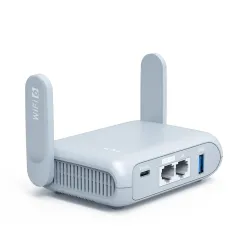
How Much Data Do You Actually Need?
Before chasing unlimited plans, figure out your actual monthly usage. Most people overestimate how much data they need:
| Activity | Data Per Hour | 8 Hours/Day for a Month |
|---|---|---|
| Video calls (1080p) | 1.5-2.5 GB | 240-400 GB |
| Video calls (720p) | 0.8-1.5 GB | 128-240 GB |
| Web browsing / email / Slack | 0.1-0.3 GB | 16-48 GB |
| Music streaming (high quality) | 0.15 GB | 24 GB |
| Video streaming (1080p) | 3 GB | 480 GB |
| Video streaming (720p) | 1.5 GB | 240 GB |
| Cloud sync (light use) | 0.2-0.5 GB | 32-80 GB |
Typical remote worker (no video streaming): 50-100 GB per month. A plan with 50 GB premium data and unlimited deprioritized data handles this comfortably.
Remote worker who streams in the evening: 100-200 GB per month. You will hit the deprioritization threshold on most plans but continue with usable speeds.
Heavy user (multiple people, 4K streaming, large file transfers): 200-500+ GB per month. You need T-Mobile Home Internet or Calyx for genuinely unlimited data.
Deprioritization: What It Actually Feels Like
We deliberately exceeded deprioritization thresholds on all three major carriers to measure the real-world impact. Here is what happened:
T-Mobile (after 50 GB on Go5G Plus)
- Off-peak (10pm-8am): Zero noticeable difference. Speeds remained at 80-200 Mbps.
- Normal hours (8am-5pm, suburban): Minimal impact. Speeds dropped from 150 Mbps to 80-100 Mbps.
- Peak hours (5pm-9pm, urban): Noticeable slowdown to 15-40 Mbps. Still usable for video calls and work.
- Peak hours (5pm-9pm, congested downtown): Dropped to 5-15 Mbps. Zoom calls worked at 720p but occasionally pixelated. File uploads were slow.
AT&T (after 60 GB on Unlimited Premium)
- Off-peak: No noticeable difference.
- Normal hours: Similar to T-Mobile — modest slowdown.
- Peak hours (urban): Dropped to 8-20 Mbps. More aggressive deprioritization than T-Mobile in our testing locations.
Verizon (after 60 GB on Unlimited Ultimate)
- Off-peak: No noticeable difference.
- Peak hours: The most aggressive deprioritization in our testing. Speeds dropped to 3-10 Mbps in congested areas, making video calls unreliable.
Bottom line: Deprioritization is not the end of the world — it is the back of the line, not a brick wall. T-Mobile’s deprioritization was the least aggressive in our testing, making it our recommended carrier for heavy hotspot users.
How to Minimize Data Usage on a Hotspot
Even with unlimited data, managing usage improves your experience — especially when you are on a deprioritized connection:
Video Calls (Biggest Consumer)
- Set Zoom/Google Meet to 720p resolution (saves 50% bandwidth vs 1080p)
- Turn off camera when possible (audio-only uses 1/10th the data of video)
- Close other bandwidth-consuming apps during calls
Streaming
- Download content on WiFi (accommodation, cafe) for offline viewing
- Set Netflix/YouTube to SD or 720p when on hotspot (1080p streaming uses 3 GB/hour, 720p uses 1.5 GB/hour)
- Use audio-only streaming for music (Spotify at high quality uses 150 MB/hour vs 3 GB/hour for video)
Cloud Sync and Backups
- Pause Dropbox, Google Drive, and iCloud sync during peak usage
- Schedule large file uploads for overnight or off-peak hours
- Use selective sync to avoid downloading entire cloud drives
System Updates
- Disable automatic OS and app updates when on hotspot
- Queue updates for when you have access to WiFi
- Windows 11: Set your hotspot connection as “metered” to prevent background downloads
International Unlimited Data
For travelers outside the US, unlimited data works differently. Carrier plans generally do not offer international roaming with full speeds. Instead, consider:
- eSIM providers like Saily and Airalo offer regional unlimited data plans for $15-50 per week in many countries. These eSIMs work in your phone or a hotspot device with eSIM support.
- Local SIM cards often offer unlimited or high-volume data plans at local prices ($10-30/month for 50-100 GB in Southeast Asia, $20-40/month in Europe).
- Holafly offers unlimited data eSIMs for specific countries and regions — see our best eSIM unlimited data guide.
For international travel, an eSIM with a local or regional data plan is almost always cheaper and faster than international roaming.
The Bottom Line
For stationary unlimited data, T-Mobile 5G Home Internet ($50/month) is unbeatable — truly unlimited with no throttling at a price no other plan matches.
For portable unlimited data, the Netgear Nighthawk M6 with a T-Mobile Go5G Plus SIM provides the best combination of hardware quality, data allotment (50 GB premium + unlimited deprioritized), and portability.
For budget unlimited, a GL.iNet Beryl AX travel router ($80) paired with your existing phone plan maximizes data you are already paying for.
For international travelers, eSIMs from Saily or Airalo provide affordable data without carrier roaming fees.
The reality is that “unlimited” always comes with trade-offs — speed reduction after a threshold, fixed-location requirements, or limited device compatibility. The best strategy is to choose the plan with the highest premium data threshold for your usage pattern and supplement with WiFi whenever available.
For more hotspot recommendations, see our best mobile hotspots overall guide, best mobile hotspot for Europe, and best mobile hotspot for RV guide. For comparing hotspots to other solutions, see our 5G hotspot vs 4G analysis.
Frequently Asked Questions
Is there a truly unlimited mobile hotspot?
Yes, but with caveats. T-Mobile's 5G Home Internet provides genuinely unlimited data with no throttling or deprioritization caps for $50/month. The catch is that it is technically address-locked (though enforcement varies) and the gateway requires AC power. For portable hotspots, T-Mobile's Go5G Plus plan includes 50 GB of premium hotspot data, after which speeds are deprioritized (not hard-throttled). Calyx Institute offers unlimited hotspot data on T-Mobile's network for a tax-deductible annual donation of around $500. No major US carrier offers truly unlimited data on a portable hotspot without some form of deprioritization or speed reduction after a threshold.
What happens when you hit your hotspot data cap?
It depends on the carrier and plan. With deprioritization (T-Mobile Go5G Plus, AT&T Unlimited Premium), your data continues but may slow down during network congestion -- you are moved to the back of the queue behind other users. During low congestion periods, speeds are unaffected. With hard throttling (older plans, lower-tier plans), your speeds are reduced to a fixed rate (often 600 Kbps to 3 Mbps) regardless of congestion. With a hard cap (some prepaid plans), data stops entirely. Deprioritization is significantly better than throttling because you only slow down when the tower is busy.
What is the cheapest unlimited hotspot plan?
T-Mobile's 5G Home Internet at $50/month is the cheapest truly unlimited option, but it requires AC power and a fixed location. For portable use, T-Mobile's Prepaid Hotspot plan offers 50 GB for $50/month (not truly unlimited). The best value for heavy data users is Calyx Institute, which offers unlimited hotspot data on T-Mobile's network for roughly $500 per year (about $42/month equivalent), funded as a tax-deductible donation. For international travelers, eSIM providers like Saily and Airalo offer regional unlimited data plans starting at $10-30 per week.
Can I use a phone hotspot as my main internet?
Yes, with limitations. Phone plans with hotspot data (T-Mobile Go5G Plus includes 50 GB, AT&T Unlimited Premium includes 60 GB) can serve as primary internet for light to moderate use. For heavy use (video streaming, large file transfers, video calls all day), dedicated hotspot devices with dedicated data plans are better because they do not drain your phone battery, offer external antenna support for better reception, and provide a stable WiFi network for multiple devices. Phone tethering through a travel router (like the GL.iNet Beryl AX) is a good middle ground.
Which carrier has the best unlimited hotspot plan?
T-Mobile offers the best unlimited hotspot options in 2026. Their 5G Home Internet is truly unlimited at $50/month for stationary use. Their Go5G Plus phone plan includes 50 GB of premium hotspot data -- the most of any premium phone plan. T-Mobile also has the widest 5G coverage and fastest average speeds. AT&T's Unlimited Premium plan includes 60 GB of hotspot data with 5G access. Verizon's Unlimited Ultimate includes 60 GB but Verizon's 5G coverage is more limited outside of cities.
Do I need 5G for a mobile hotspot?
Not necessarily. 4G LTE delivers 20-80 Mbps in most areas, which is more than enough for video calls, streaming, and remote work. 5G improves speeds to 100-300+ Mbps in covered areas, but coverage is limited to urban and suburban locations. If you primarily use your hotspot in cities, 5G is worth it. If you travel to rural areas, a strong 4G LTE hotspot with external antenna support will outperform a 5G hotspot with no 5G coverage. For a detailed breakdown, see our 5G vs 4G hotspot comparison.